 Add to Chrome
 Add to Firefox
 Add to Edge
Converted, Not Equivalent: Benchmarking Codebase Conversion via Observational Equivalence
May 27, 2026
Coding agents increasingly act as codebase-scale collaborators that can assist with codebase conversion, but this progress has exposed a critical weakness: agents often over-trust their own local validation routines and declare success on artifacts that satisfy surface checks while violating the semantic contracts users actually care about. This problem is especially acute in codebase conversion, where prior evaluation is largely outcome-driven and therefore unstable: two implementations can match on a shallow outcome, such as a single forward loss, while diverging in gradients, optimizer behavior, or short-horizon training dynamics. We introduce T2J-Bench, a benchmark for codebase conversion that reformulates conversion as transfer under a fixed equivalence contract. A fixed verifier then compares source and converted codebases through three ordered stages: Spec (interface admissibility), Numeric (forward outputs, losses, gradients, and objective-specific tensors), and Behavioral (short training dynamics under fixed seeds). Across 355 blind conversion attempts, the best system reaches only 26.7--28.9% overall pass rate despite Spec pass rates up to 91.1%; a 4.7x token-budget spread yields only a 2.2x pass-rate spread; and all systems overestimate success by 66.6--97.8 points relative to the fixed evaluator. This suggests that failures stem more from contract-misaligned self-validation than from limited budget or backbone strength.

ScientistOne: Towards Human-Level Autonomous Research via Chain-of-Evidence
May 25, 2026Autonomous research agents produce competitive solutions and professional-looking manuscripts, yet their outputs contain verifiability failures undetectable by surface-level evaluation: fabricated citations, unreproducible scores, and method descriptions that diverge from the implementation. We address this through three contributions. First, Chain-of-Evidence (CoE), a verifiability framework requiring every claim to be traceable to its evidence source. Second, ScientistOne, an end-to-end autonomous research system that maintains evidence chains by construction throughout literature review, solution discovery, and paper writing. Third, CoE Audit, a post-hoc audit whose four integrity checks -- score verification, specification violation, reference verification, and method-code alignment -- apply uniformly to all systems. Across 75 papers spanning five systems and five frontier research tasks, every baseline exhibits at least one systematic failure mode: hallucinated reference rates reach 21%, score verification passes in as few as 42% of papers, and method-code alignment ranges from 20% to 80%. ScientistOne achieves zero hallucinated references (0/337), perfect score verification (12/12), and the highest method-code alignment (14/15), while matching or exceeding human expert performance on all five tasks. ScientistOne further generalizes to six additional tasks spanning medical imaging, fine-grained recognition, 3D perception, and language modeling, achieving state-of-the-art on Parameter Golf and gold medals on MLE-Bench tasks where baselines fail entirely.
Nexus : An Agentic Framework for Time Series Forecasting
May 14, 2026Time series forecasting is not just numerical extrapolation, but often requires reasoning with unstructured contextual data such as news or events. While specialized Time Series Foundation Models (TSFMs) excel at forecasting based on numerical patterns, they remain unaware to real-world textual signals. Conversely, while LLMs are emerging as zero-shot forecasters, their performance remains uneven across domains and contextual grounding. To bridge this gap, we introduce Nexus, a multi-agent forecasting framework that decomposes prediction into specialized stages: isolating macro-level and micro-level temporal fluctuations, and integrating contextual information when available before synthesizing a final forecast. This decomposition enables Nexus to adapt from seasonal signals to volatile, event-driven information without relying on external statistical anchors or monolithic prompting. We show that current-generation LLMs possess substantially stronger intrinsic forecasting ability than previously recognized, depending critically on how numerical and contextual reasoning are organized. Evaluated on data strictly succeeding LLM knowledge cutoffs spanning Zillow real estate metrics and volatile stock market equities, Nexus consistently matches or outperforms state-of-the-art TSFMs and strong LLM baselines. Beyond numerical accuracy, Nexus produces high-quality reasoning traces that explicitly show the fundamental drivers behind each forecast. Our results establish that real-world forecasting is an agentic reasoning problem extending well beyond only sequence modeling.
TFRBench: A Reasoning Benchmark for Evaluating Forecasting Systems
Apr 07, 2026We introduce TFRBench, the first benchmark designed to evaluate the reasoning capabilities of forecasting systems. Traditionally, time-series forecasting has been evaluated solely on numerical accuracy, treating foundation models as ``black boxes.'' Unlike existing benchmarks, TFRBench provides a protocol for evaluating the reasoning generated by forecasting systems--specifically their analysis of cross-channel dependencies, trends, and external events. To enable this, we propose a systematic multi-agent framework that utilizes an iterative verification loop to synthesize numerically grounded reasoning traces. Spanning ten datasets across five domains, our evaluation confirms that this reasoning is causally effective; useful for evaluation; and prompting LLMs with our generated traces significantly improves forecasting accuracy compared to direct numerical prediction (e.g., avg. $\sim40.2\%\to56.6\%)$, validating the quality of our reasoning. Conversely, benchmarking experiments reveal that off-the-shelf LLMs consistently struggle with both reasoning (lower LLM-as-a-Judge scores) and numerical forecasting, frequently failing to capture domain-specific dynamics. TFRBench thus establishes a new standard for interpretable, reasoning-based evaluation in time-series forecasting. Our benchmark is available at: https://tfrbench.github.io
PaperOrchestra: A Multi-Agent Framework for Automated AI Research Paper Writing
Apr 06, 2026Synthesizing unstructured research materials into manuscripts is an essential yet under-explored challenge in AI-driven scientific discovery. Existing autonomous writers are rigidly coupled to specific experimental pipelines, and produce superficial literature reviews. We introduce PaperOrchestra, a multi-agent framework for automated AI research paper writing. It flexibly transforms unconstrained pre-writing materials into submission-ready LaTeX manuscripts, including comprehensive literature synthesis and generated visuals, such as plots and conceptual diagrams. To evaluate performance, we present PaperWritingBench, the first standardized benchmark of reverse-engineered raw materials from 200 top-tier AI conference papers, alongside a comprehensive suite of automated evaluators. In side-by-side human evaluations, PaperOrchestra significantly outperforms autonomous baselines, achieving an absolute win rate margin of 50%-68% in literature review quality, and 14%-38% in overall manuscript quality.
PathCRF: Ball-Free Soccer Event Detection via Possession Path Inference from Player Trajectories
Feb 12, 2026Despite recent advances in AI, event data collection in soccer still relies heavily on labor-intensive manual annotation. Although prior work has explored automatic event detection using player and ball trajectories, ball tracking also remains difficult to scale due to high infrastructural and operational costs. As a result, comprehensive data collection in soccer is largely confined to top-tier competitions, limiting the broader adoption of data-driven analysis in this domain. To address this challenge, this paper proposes PathCRF, a framework for detecting on-ball soccer events using only player tracking data. We model player trajectories as a fully connected dynamic graph and formulate event detection as the problem of selecting exactly one edge corresponding to the current possession state at each time step. To ensure logical consistency of the resulting edge sequence, we employ a Conditional Random Field (CRF) that forbids impossible transitions between consecutive edges. Both emission and transition scores dynamically computed from edge embeddings produced by a Set Attention-based backbone architecture. During inference, the most probable edge sequence is obtained via Viterbi decoding, and events such as ball controls or passes are detected whenever the selected edge changes between adjacent time steps. Experiments show that PathCRF produces accurate, logically consistent possession paths, enabling reliable downstream analyses while substantially reducing the need for manual event annotation. The source code is available at https://github.com/hyunsungkim-ds/pathcrf.git.
MARS: Modular Agent with Reflective Search for Automated AI Research
Feb 02, 2026Automating AI research differs from general software engineering due to computationally expensive evaluation (e.g., model training) and opaque performance attribution. Current LLM-based agents struggle here, often generating monolithic scripts that ignore execution costs and causal factors. We introduce MARS (Modular Agent with Reflective Search), a framework optimized for autonomous AI research. MARS relies on three pillars: (1) Budget-Aware Planning via cost-constrained Monte Carlo Tree Search (MCTS) to explicitly balance performance with execution expense; (2) Modular Construction, employing a "Design-Decompose-Implement" pipeline to manage complex research repositories; and (3) Comparative Reflective Memory, which addresses credit assignment by analyzing solution differences to distill high-signal insights. MARS achieves state-of-the-art performance among open-source frameworks on MLE-Bench under comparable settings, maintaining competitiveness with the global leaderboard's top methods. Furthermore, the system exhibits qualitative "Aha!" moments, where 63% of all utilized lessons originate from cross-branch transfer, demonstrating that the agent effectively generalizes insights across search paths.
PaperBanana: Automating Academic Illustration for AI Scientists
Jan 30, 2026Despite rapid advances in autonomous AI scientists powered by language models, generating publication-ready illustrations remains a labor-intensive bottleneck in the research workflow. To lift this burden, we introduce PaperBanana, an agentic framework for automated generation of publication-ready academic illustrations. Powered by state-of-the-art VLMs and image generation models, PaperBanana orchestrates specialized agents to retrieve references, plan content and style, render images, and iteratively refine via self-critique. To rigorously evaluate our framework, we introduce PaperBananaBench, comprising 292 test cases for methodology diagrams curated from NeurIPS 2025 publications, covering diverse research domains and illustration styles. Comprehensive experiments demonstrate that PaperBanana consistently outperforms leading baselines in faithfulness, conciseness, readability, and aesthetics. We further show that our method effectively extends to the generation of high-quality statistical plots. Collectively, PaperBanana paves the way for the automated generation of publication-ready illustrations.
ScholarPeer: A Context-Aware Multi-Agent Framework for Automated Peer Review
Jan 30, 2026Automated peer review has evolved from simple text classification to structured feedback generation. However, current state-of-the-art systems still struggle with "surface-level" critiques: they excel at summarizing content but often fail to accurately assess novelty and significance or identify deep methodological flaws because they evaluate papers in a vacuum, lacking the external context a human expert possesses. In this paper, we introduce ScholarPeer, a search-enabled multi-agent framework designed to emulate the cognitive processes of a senior researcher. ScholarPeer employs a dual-stream process of context acquisition and active verification. It dynamically constructs a domain narrative using a historian agent, identifies missing comparisons via a baseline scout, and verifies claims through a multi-aspect Q&A engine, grounding the critique in live web-scale literature. We evaluate ScholarPeer on DeepReview-13K and the results demonstrate that ScholarPeer achieves significant win-rates against state-of-the-art approaches in side-by-side evaluations and reduces the gap to human-level diversity.
Better Prevent than Tackle: Valuing Defense in Soccer Based on Graph Neural Networks
Dec 11, 2025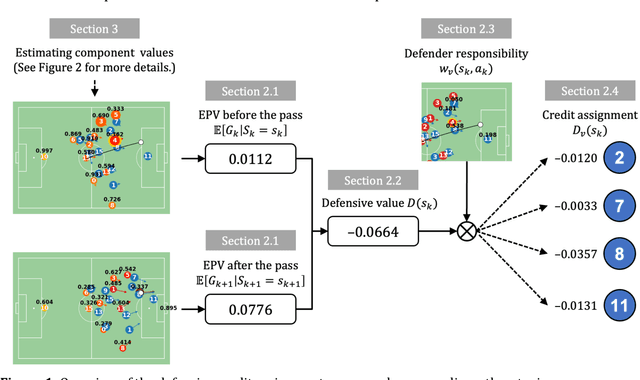
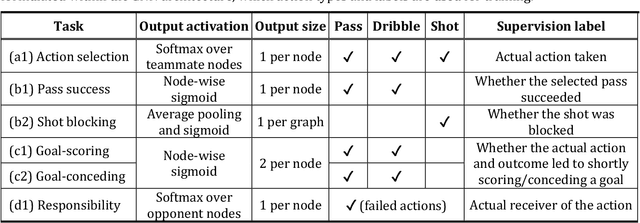
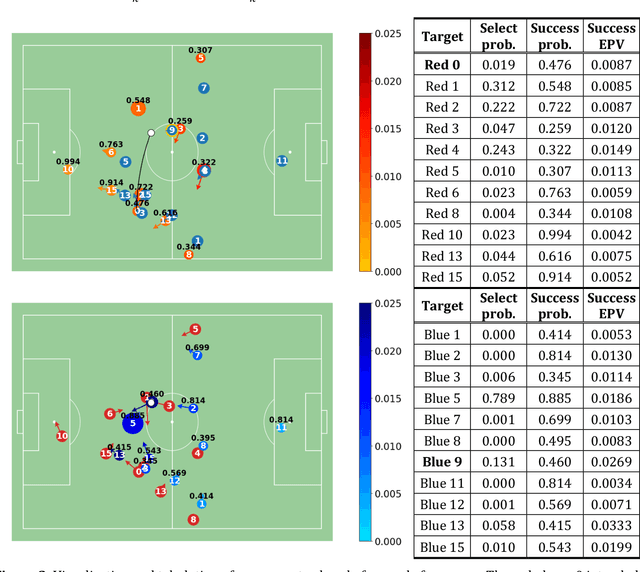
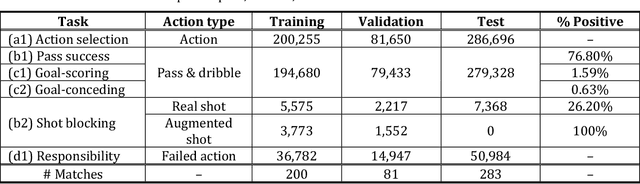
Evaluating defensive performance in soccer remains challenging, as effective defending is often expressed not through visible on-ball actions such as interceptions and tackles, but through preventing dangerous opportunities before they arise. Existing approaches have largely focused on valuing on-ball actions, leaving much of defenders' true impact unmeasured. To address this gap, we propose DEFCON (DEFensive CONtribution evaluator), a comprehensive framework that quantifies player-level defensive contributions for every attacking situation in soccer. Leveraging Graph Attention Networks, DEFCON estimates the success probability and expected value of each attacking option, along with each defender's responsibility for stopping it. These components yield an Expected Possession Value (EPV) for the attacking team before and after each action, and DEFCON assigns positive or negative credits to defenders according to whether they reduced or increased the opponent's EPV. Trained on 2023-24 and evaluated on 2024-25 Eredivisie event and tracking data, DEFCON's aggregated player credits exhibit strong positive correlations with market valuations. Finally, we showcase several practical applications, including in-game timelines of defensive contributions, spatial analyses across pitch zones, and pairwise summaries of attacker-defender interactions.